
Everything on this page is either standard Markdown or a render hook that enriches it, so the same files render fine anywhere, just plainer. Nothing here locks a post to this theme, and that is deliberate: prefer these over a shortcode wherever both would work.
The theme does also ship shortcodes for the things Markdown cannot express. They are additive, and they carry a cost this page does not — read the trade before reaching for one.
Front matter#
| Key | What it does |
|---|---|
title, description, date, draft, tags | The standard set. description becomes the lede, the meta description, the card summary and the RSS description. |
lastmod | Updated date. Shown only when showDateUpdated is on and this is later than date. |
showTableOfContents | Per-post override of the site default. |
showHero | Hide the cover on one post. |
heroStyle | Per-post hero treatment: basic, big, background, thumbAndBackground. |
coverAlt | Alt text for the cover. Empty by default, correct for artwork that repeats the title. |
robots | noindex, follow and similar. Cascades, so setting it on a section covers everything under it. |
sitemap_exclude | Keep a page out of sitemap.xml. |
excludeFromSearch | Keep a page out of the ⌘K index. Separate from the above, because “do not index this” and “do not surface this in site search” are different intentions. |
externalUrl | Point the listing entry at another site. |
editURL, editAppendPath | Per-page override of the edit link. |
series, series_order | Group a post into a multi-part series. See below. |
authors | Credit several people, by key from data/authors/. Omit it and the post falls back to the site-wide author. |
Hero styles#
heroStyle picks how the cover is presented. Set it site-wide in
Configuration or per post in front matter.
| Style | What it does |
|---|---|
basic | A bordered card above the body. The default |
big | The same, breaking out past the text measure |
background | The cover behind the header, title over a scrim |
thumbAndBackground | Both: behind the header, and again as a card |
Every style keeps the cover whole. The box is an exact 1200×630 ratio with
object-fit: contain, so a cover that is not 1200×630 letterboxes rather than losing its
edges. A background hero elsewhere fills an arbitrary band and crops to fit; this one does
not, because a cover with its title in the artwork loses the title to a crop.
That constraint decides which artwork suits which style. background and
thumbAndBackground put the title on top of the cover, so artwork that already carries
the title will show it twice. Use those two with textless artwork, and basic or big
with a cover that has words in it.
Below 720px the scrim would cover most of a short hero, so the header moves under the image instead of over it and goes back to the normal text colours. A title that is illegible is worse than a hero that is less dramatic.
SVG covers work. Hugo cannot resize an SVG or read its pixel dimensions, so the theme skips both for vector covers and lets CSS hold the box instead.
Series#
A post that is part of a longer piece gets a navigation block above its body: which part this is, how many there are, and a link to each of the others. The post you are reading is not in one; any of the three “Design decisions” posts shows it live.
series: ["Design decisions"]
series_order: 2
Register the taxonomy first. Nothing renders without it, because Hugo builds no term pages to link to:
[taxonomies]
  tag = "tags"
  series = "series"
series_order decides the order, and it is not optional. Hugo has nothing else to
sort on, and a series listed in an arbitrary order is worse than no series block at all —
so a post in a series without one fails the build rather than rendering a scrambled
list. The order is independent of date, which is the point: a series can be written out
of sequence, or an earlier part revised later, without the navigation changing.
The block is a <details>, so it needs no JavaScript and collapses on its own.
article.seriesOpened sets whether it starts expanded; collapsed is the default, since
the summary line already says which part you are on and a reader who arrived at part 3 did
not come for the table of contents. The current part is plain text rather than a link,
carrying aria-current="page" — a link to the page you are already on is a dead end.
A series with only one post in it renders nothing. That is not a series yet.
Maths#
Equations are rendered at build time, so the theme ships no maths library: no JavaScript, no stylesheet, and none of the font files a client-side renderer needs. The equation is in the HTML the server sends, which means it is there with scripting off, in a feed reader, and anywhere else that reads the page without executing it.
Inline maths uses \( and \):
The quadratic formula is , which every schoolchild is made to memorise.
Display maths uses $$:
Turn it on in your own config, because Goldmark has to be told to hand the delimiters through untouched. This is site config rather than a theme setting, and a site that wants no maths configures nothing and pays nothing:
[markup.goldmark.extensions.passthrough]
  enable = true
  [markup.goldmark.extensions.passthrough.delimiters]
    block  = [["\\[", "\\]"], ["$$", "$$"]]
    inline = [["\\(", "\\)"]]
Output is MathML, which browsers lay out natively. Hugo can also emit KaTeX’s own HTML alongside it, but that needs KaTeX’s stylesheet and around sixty font files to look right — the exact weight this approach avoids.
A malformed expression fails the build rather than rendering as its own raw LaTeX, which is the kind of thing an author notices weeks later.
Admonitions#
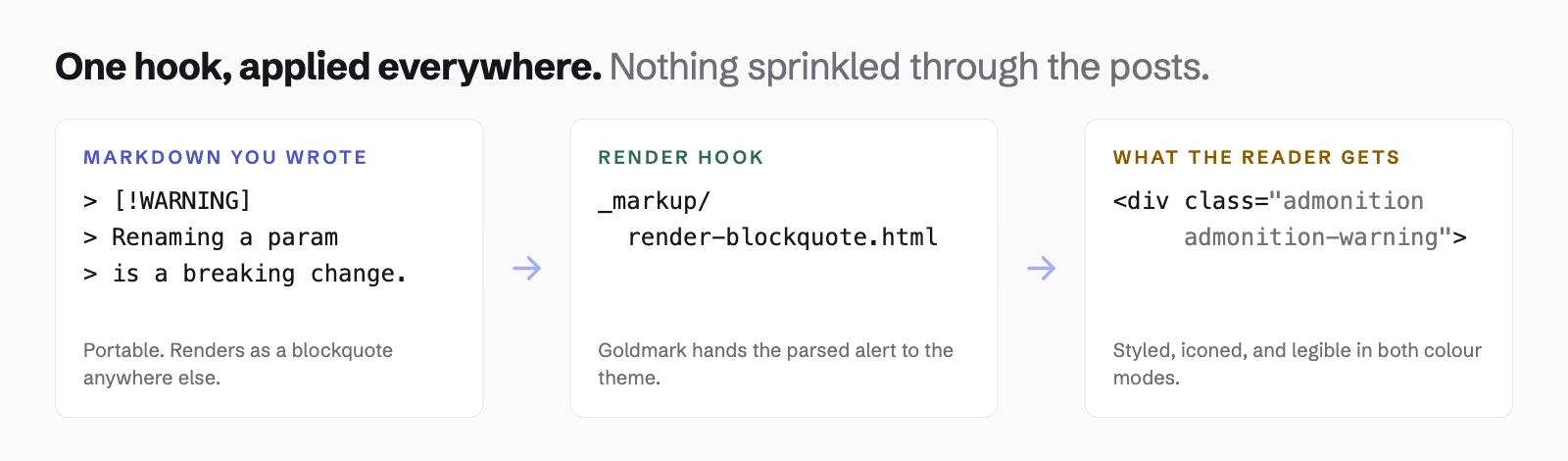
Callouts use GitHub’s alert syntax. Paste any of these into a GitHub README and they render as ordinary blockquotes: quieter, but never broken.
> [!WARNING]
> Renaming a published config key is a breaking change.
All five, live:
Note
Useful information a reader should notice even when skimming.
Tip
Optional, but it will make something easier.
Important
Necessary to succeed. Not optional.
Warning
Needs immediate attention because of the risk it carries.
Caution
Consequences of getting it wrong.
Their colours sit outside the palette system, because a caution should read as a caution whether the site runs periwinkle, sage or clay. Every label and body colour is measured at 4.5:1 or better against its own tinted background in both modes.
An unrecognised type emits a build warning and falls back to a plain blockquote, so a typo surfaces at build time rather than in production.
A plain blockquote still looks like a plain blockquote:
The theme replaces a larger one. An audit found roughly two thirds of that theme unused by the site it served, which is the whole reason this one exists.
Images#
Write an ordinary Markdown image. Local images get intrinsic width and height so the
article never reflows as they load, a srcset capped at the original, and lazy loading.
The quoted title becomes a caption. Captions need
wrapStandAloneImageWithinParagraph = false and only apply to an image alone in its own
paragraph, because a <figure> inside a <p> is invalid HTML.
Dark variants#
Drop diagram-dark.png beside diagram.png and it is used whenever the dark palette is
active. Toggle the appearance control in the header and watch the diagram below change:
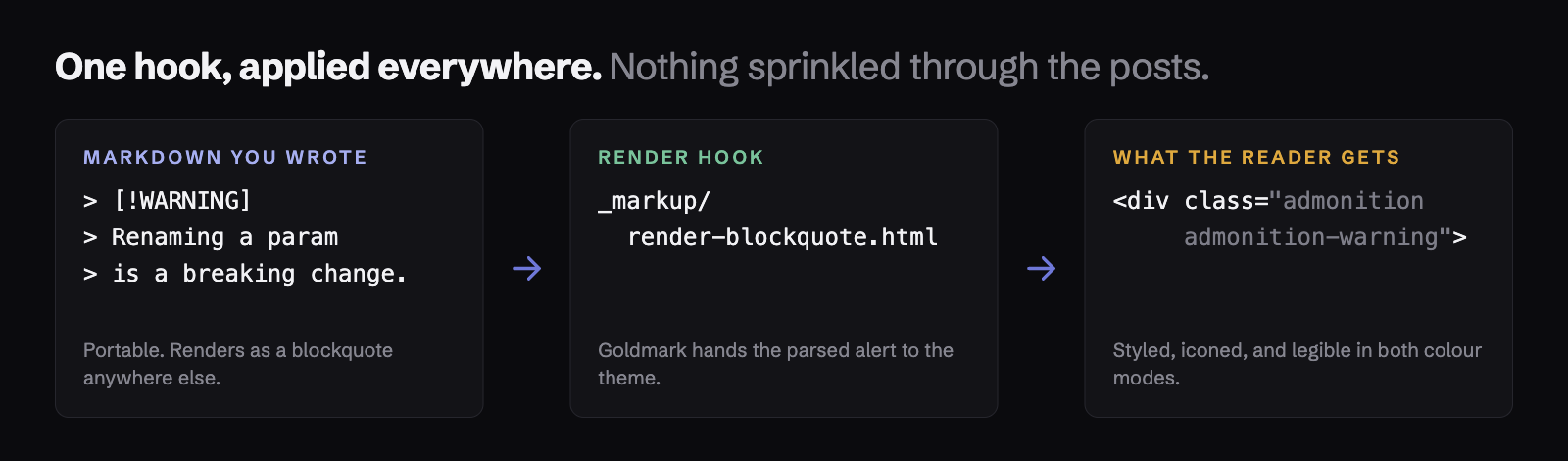
It is two <img> elements and CSS rather than a <picture> element with a
prefers-color-scheme source. A media query only knows what the operating system wants,
and this theme lets a reader override that, so <picture> would show the wrong artwork
to exactly the readers who cared enough to choose.
Remote URLs and anything in static/ pass through with lazy loading and nothing else.
Hugo cannot measure a file it does not manage, and a made-up width is worse than none.
SVG and GIF skip resizing too: SVG has no raster size, and a resized GIF stops animating.
Code#
Fences work as normal. Add {file="..."} and the block grows a filename bar:
```go {file="main.go"}
func main() {}
```
Which renders as:
package main

import "fmt"

// Every Chroma token class is styled for both colour modes. Comments in
// particular are measured, because they are the first thing to fail contrast.
func main() {
	things := map[string]int{"alpha": 1, "beta": 2}
	for name, count := range things {
		fmt.Printf("%s = %d\n", name, count)
	}
}services:
web:
image: nginx:1.27-alpine
ports:
- "8080:80"
environment:
TZ: Europe/OsloAll 84 Chroma token classes are styled for light and dark, and every one is verified at 4.5:1 or better against the code background.
Tables#
Wide tables scroll inside their own container rather than pushing the page sideways. The container is focusable, because a scrollable region that cannot be focused is unreachable without a mouse.
| Component | Degrades to | Needs JavaScript |
|---|---|---|
| Table of contents | A plain list of working links | For scroll-spy only |
| Code copy | Selectable code | Yes |
| Appearance toggle | Follows prefers-color-scheme | For the override only |
| Search | Nothing. It disappears. | Yes |
| Reading progress | Nothing | Yes |
Embedded media#
Raw HTML never passes through a render hook, so embeds are handled in CSS instead. A
pasted embed carrying width="1200" is contained rather than allowed to break the
layout on a phone.
iframe elements have no intrinsic aspect ratio, so 16/9 is assumed because video is
what people actually embed. Anything else overrides it inline:
<iframe src="..." style="aspect-ratio: 4/3"></iframe>Footnotes#
Standard Markdown footnotes work and are linked in both directions.1
Which is the point. Nothing here is theme-specific syntax. ↩︎