
The theme Northlight replaces ships about forty-five shortcodes. An audit of every post on the site using it found that exactly zero appeared in any of them.
Unused surface is not free#
Every shortcode is a template to maintain, a name to document, and a behaviour someone will eventually depend on. Shipping forty-five of them to cover the handful a given site might want is a trade that only looks good before the maintenance starts.
What replaces them#
Markdown, and render hooks for the cases where markdown alone is not enough. A hook applies automatically to content that is already written, which is the opposite of a shortcode: nothing has to be sprinkled through the posts to switch it on.
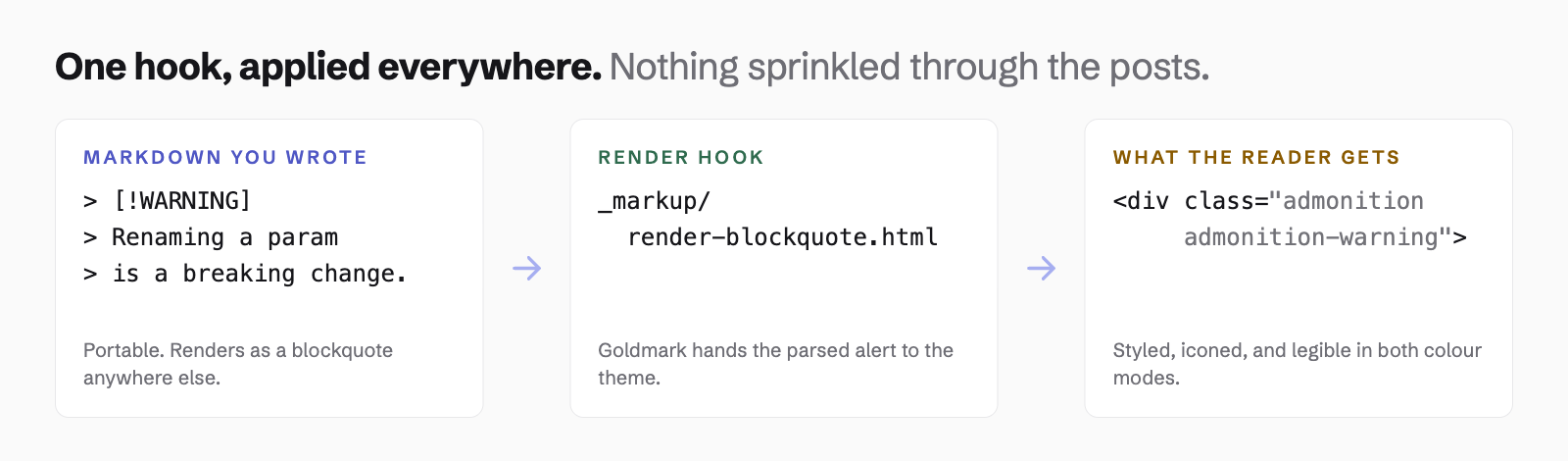
The distinction that matters is portability. A shortcode is theme-specific syntax, so content written with it only renders correctly inside this theme. A render hook enriches standard markdown, so the same file renders fine anywhere — just plainer.
Admonitions#
Callouts use GitHub’s alert syntax rather than a shortcode, for exactly that reason:
Note
The source for this block is four ordinary lines of markdown. Paste it into a GitHub README or a plain markdown previewer and it renders as a blockquote — quieter, but never broken.
Tip
Give a code fence a {file="path/to/thing.yaml"} attribute and it grows a filename
bar. Another hook, same idea.
Important
Five types are recognised: note, tip, important, warning and caution. Their colours sit outside the palette system, because a caution should be red whether the site is running periwinkle, sage or clay.
Warning
An unrecognised alert type is not silently ignored. It emits a build warning and falls back to a plain blockquote, so a typo surfaces at build time rather than in production.
Caution
Renaming a published config param is a breaking change. Once a theme is public, its config keys are API.
Images#
The image hook does the unglamorous work. Every local image ships with its intrinsic
width and height, so the article never reflows as pictures arrive, and it generates a
srcset — the prose column is 44.2rem wide, so serving a 2400px screenshot at full size
costs a reader roughly three times the bytes they can actually use.
A markdown title becomes the caption, as on the diagram above.